Development of a SaaS autoposting service
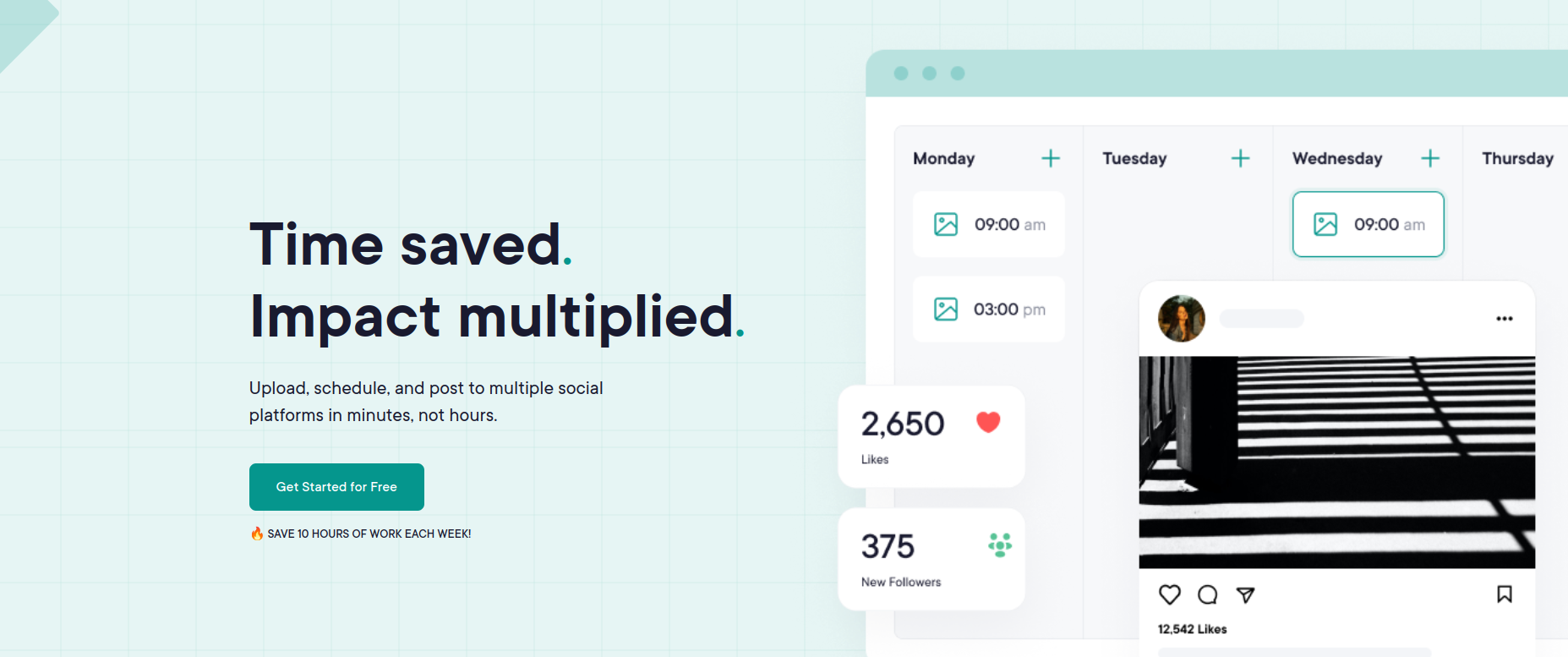
We were contacted by a company that is professionally engaged in advertising on social networks. The task is to develop a SaaS autoposting platform as a cloud service that will become a single entry point for working with different social networks and will allow SMM specialists and agencies to plan, publish and analyze content 24/7. This case is a practical example of how a web platform and subscription software help businesses build manageable content marketing processes.
Tasks and functional requirements
We designed the product as a professional tool for the daily work of teams. Key modules have been implemented as part of the development:
- Publication planning and round-the-clock uninterrupted sending of posts to various social networks.
- A modern, user-friendly and intuitive web interface for content management.
- Drag&drop-managing the publication schedule.
- Multi-accountancy and teamwork: workspaces, roles, and user rights.
- Media library for storing photos and videos.
- Collecting analytics on publications and activity.
- Notification system (for example, warnings about expired tokens and the need to reconnect).
- Subscription monetization model: accepting payments with complex billing via Stripe.
- AI-based tools: a content idea generator and an AI agent that additionally automates part of the routine (topic selection, wording, publication options, etc.).
This approach turns the software into a full-fledged business service: a single dashboard, transparent roles in teams, and stable content publishing without manual routine.

Technology stack
Architecture and development approach
In addition to creating the functionality, there was a strategic goal — to get closer to strong market players and ensure rapid product growth without architectural "brakes". Since a SaaS solution is a long-term product for a business, we initially laid out the "this is not a sprint, but a marathon" approach: the architecture should maintain a constant pace of development and scaling without regular rewrites.
Key decisions
- We chose a monolithic architecture as the most rational one at the start of a SaaS product: faster delivery of features, lower operational risks, easier maintenance.
- The modules were designed so that, if necessary, they could be separated into separate services (a gradual evolution towards microservices).
- We used DDD and TDD practices where it had the maximum effect (complex domain logic, payments, access rights, publication planning).
- We followed the SOLID principles and supported the readability and extensibility of the code, including elements of the functional approach in PHP.
The result is a reliable web product: a cloud service that can be developed iteratively, connect new social networks, add integrations and improve the user experience without losing the pace of development.
Result
The customer received a workable SaaS WEB application, ready for further scaling and development. As a result of the work, it was possible to close about 80% of the functionality relative to the market leaders — this turned out to be enough to form a strong foundation for entering a competitive niche and further increasing the advantages of the product after launch. This case is an example of software development and a web service that helps businesses manage publications, analytics, and payments in a single system.